
5/13/2026
Introducing CellDX AI Autopilot
Introducing CellDX AI Autopilot
CellDX AI Autopilot is a new way to build pathology AI models. You describe a task in plain English, and an AI agent of your choice runs the full training pipeline against our curated, commercially licensed pathology dataset. A trained, validated model is ready in about 20-30 minutes for roughly $5-$10.
What it changes
Training a pathology AI model traditionally requires three things: a licensed expensive slide cohort, a working ML environment, and the expertise to run it. Autopilot removes all three.
The dataset is included. A curated, commercially licensed feature store of 32,000+ cases and 66,000+ H&E slides ships with the platform. No data fees, no per-cohort licensing, no DUA negotiations. Cohorts that cost $50k–$200k to assemble on the open market are available to query from day one.
There's nothing to set up. No GPU provisioning, no CUDA installs, no feature extraction, no tile pipelines, no preprocessing scripts. Slides are pre-encoded with a state-of-the-art pathology foundation model (Hibou-L, 1024-dim features at 20× magnification), so the work starts where it usually ends.
No ML background required. Describe the task to your AI agent in plain English — "breast biopsies, invasive lobular vs. invasive ductal" — and the agent handles cohort selection, splits, training, and validation. Results come back in clinical terms.
It's pathology-native. The platform, models, and evaluation are built around WSI data and pathology workflows, not general-purpose ML retrofitted to slides.
How it works
A session moves through six steps.
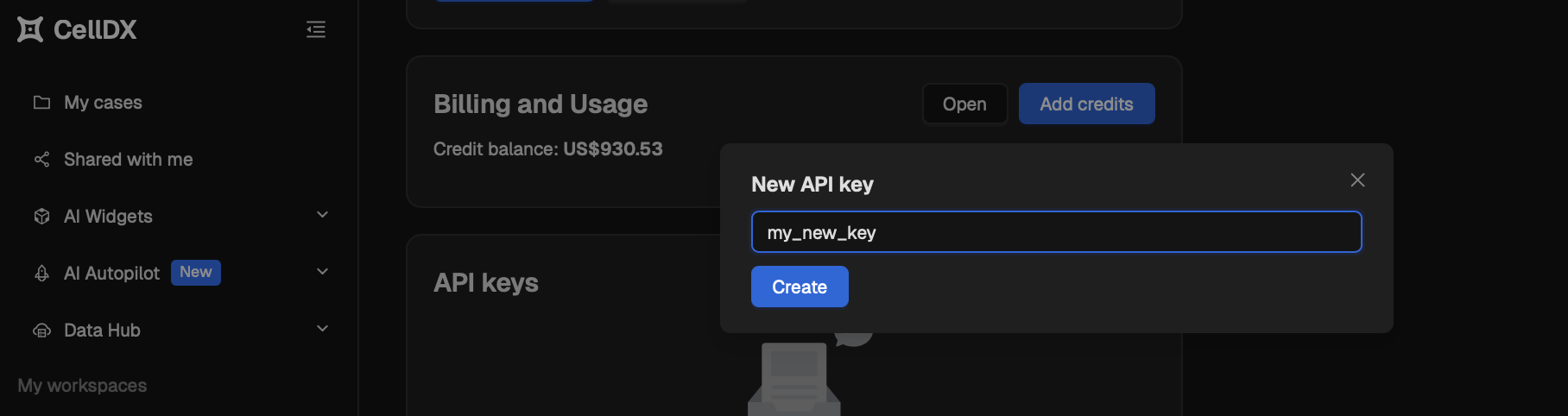
1. Set up your CellDX account and an API Key. Sign up on CellDX platform, choose a subscription plan and add a new API key.
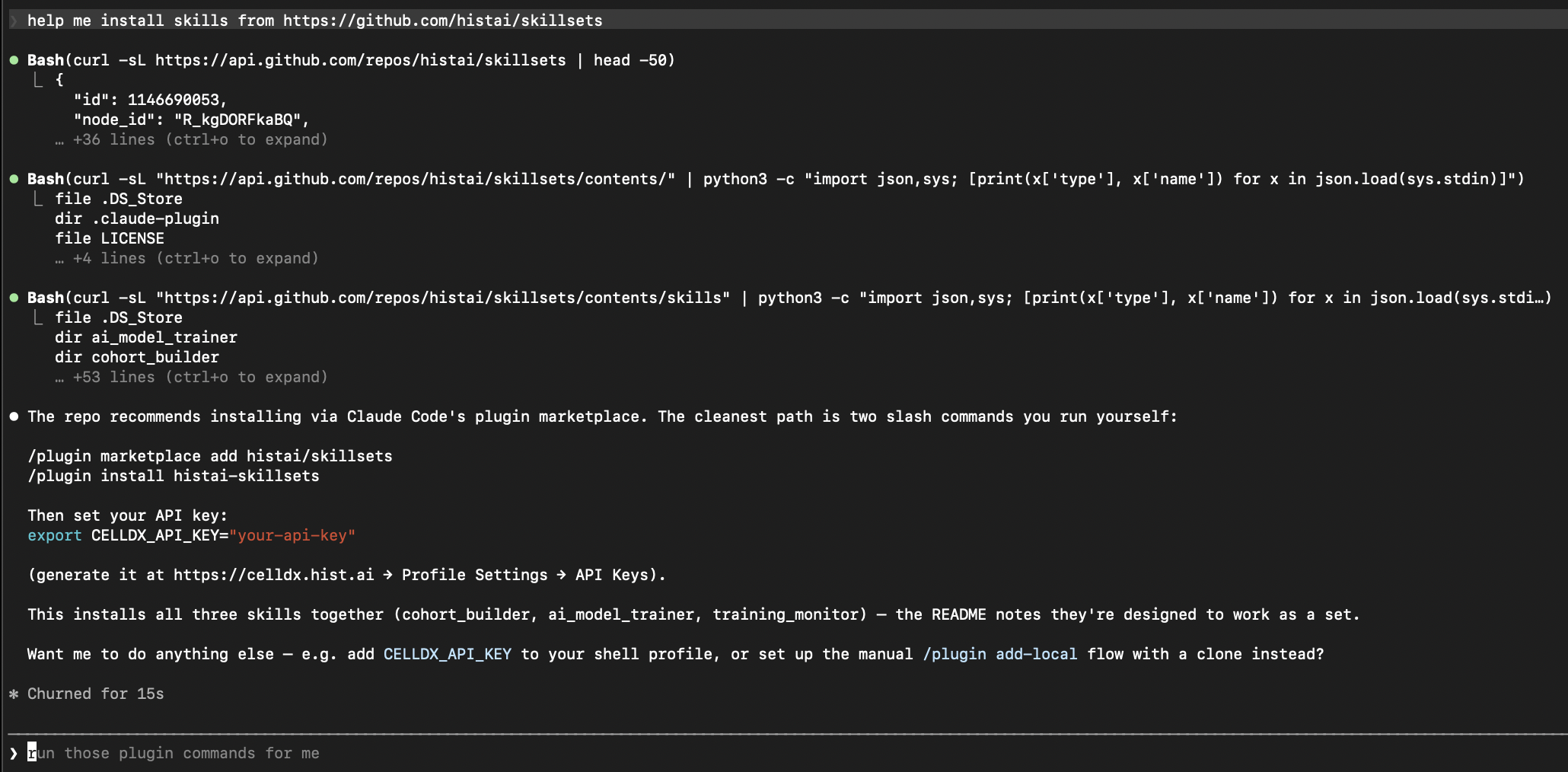
2. Configure your AI Agent. Ask your coding agent, for example, Claude Code or CODEX to install the HistAI skills (plugins) from our GitHub repository and follow the instructions.
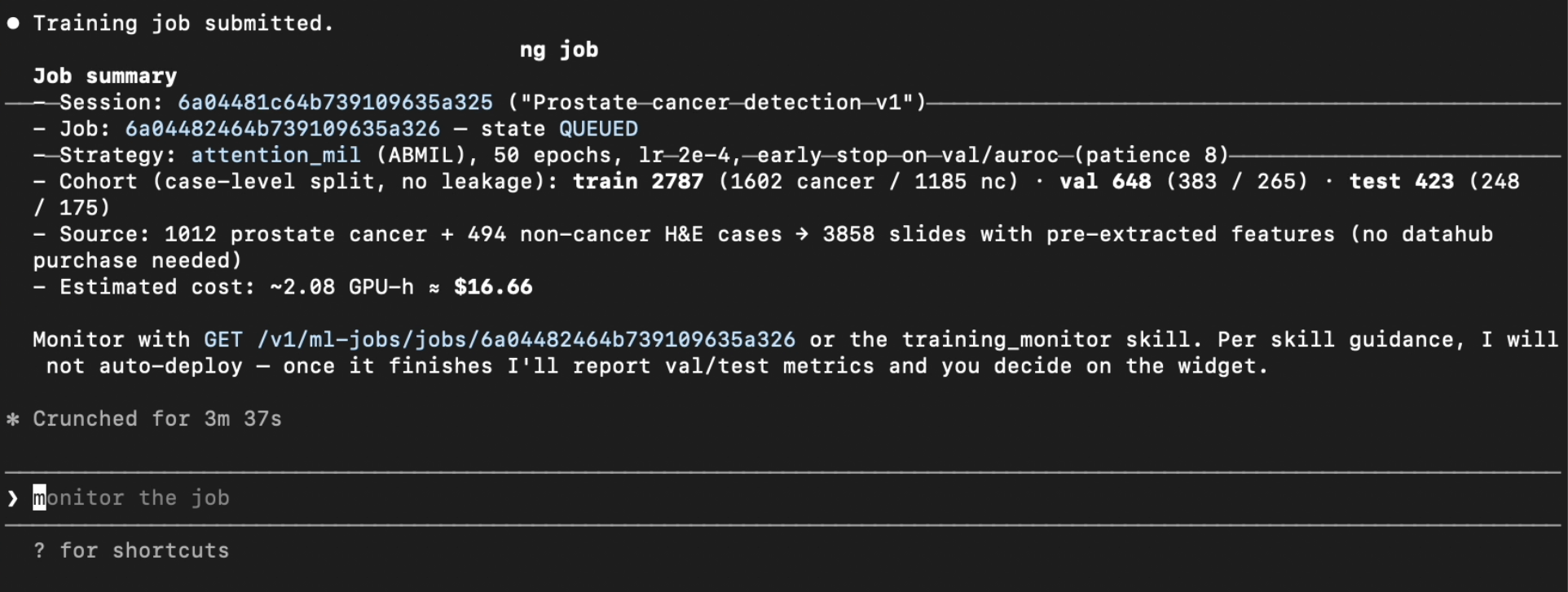
3. Describe the task. Ask your agent to train a model of your choice. The agent asks clarifying questions if the framing is ambiguous — for example, whether to treat borderline cases as their own class or merge them.
4. Confirm the cohort submit the training job. The agent queries the feature store, reports how many slides match your criteria, and proposes a train/validation split balanced by class and case. You can adjust filters before approving.
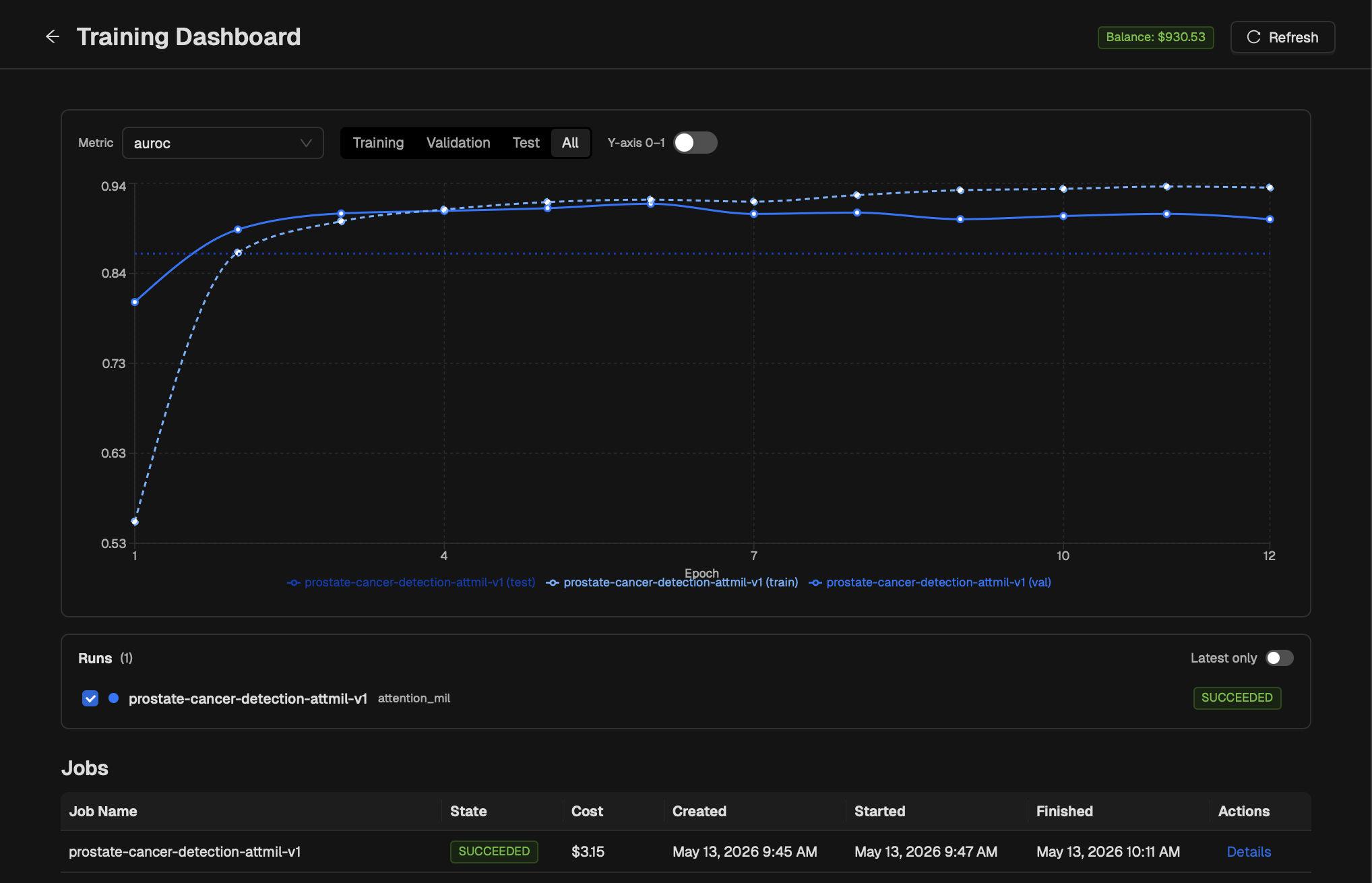
5. Review and deploy. When training finishes, the agent reports AUROC, sensitivity, specificity, and a confusion matrix. From there you can deploy the model as a custom widget or, on Business plans, download the weights to run in your own environment. You can also see the charts in your Dashboard on the CellDX Platform
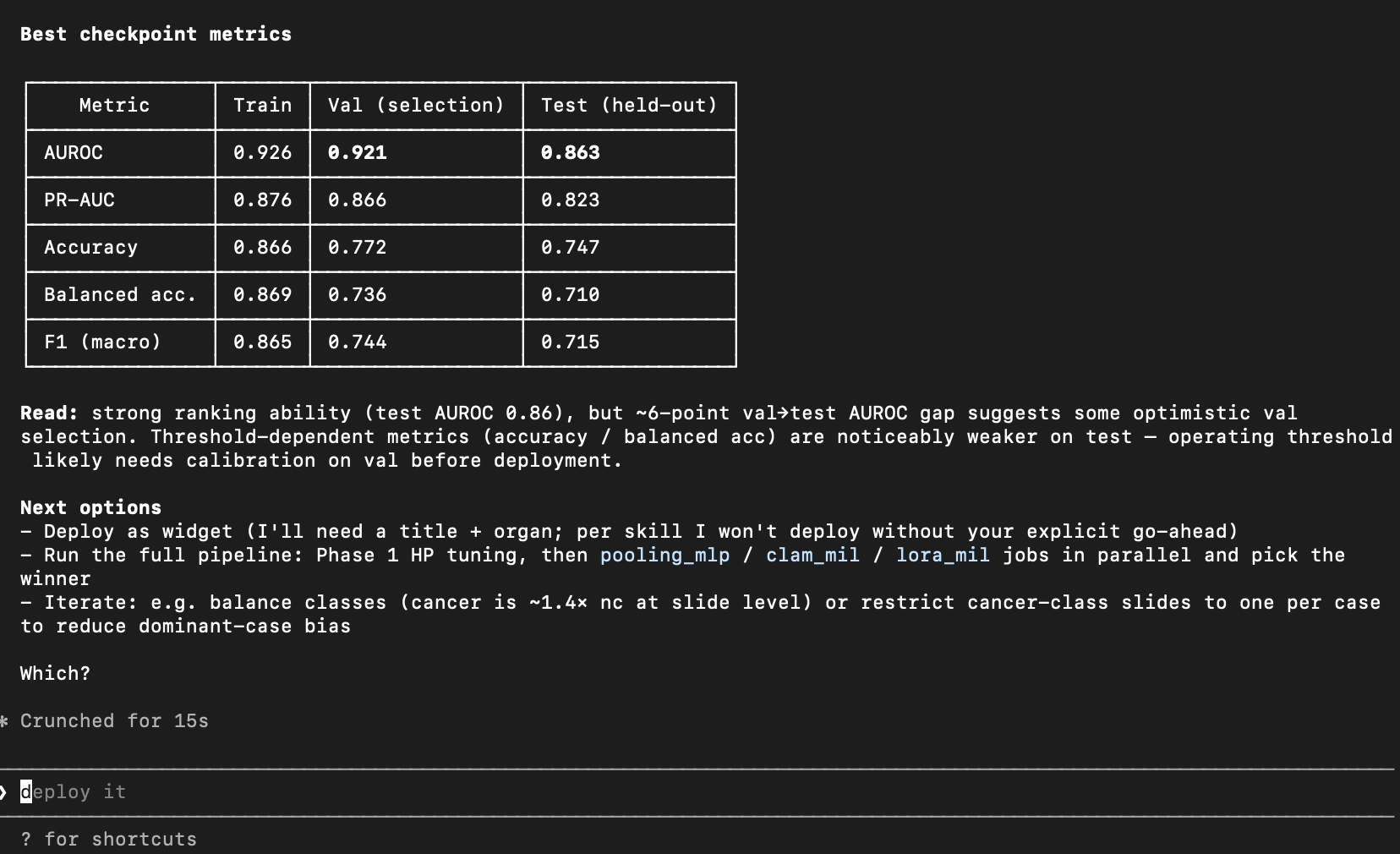
7.Run. Congratulations! You trained and deployed your custom AI model. It's time to analyse some slides.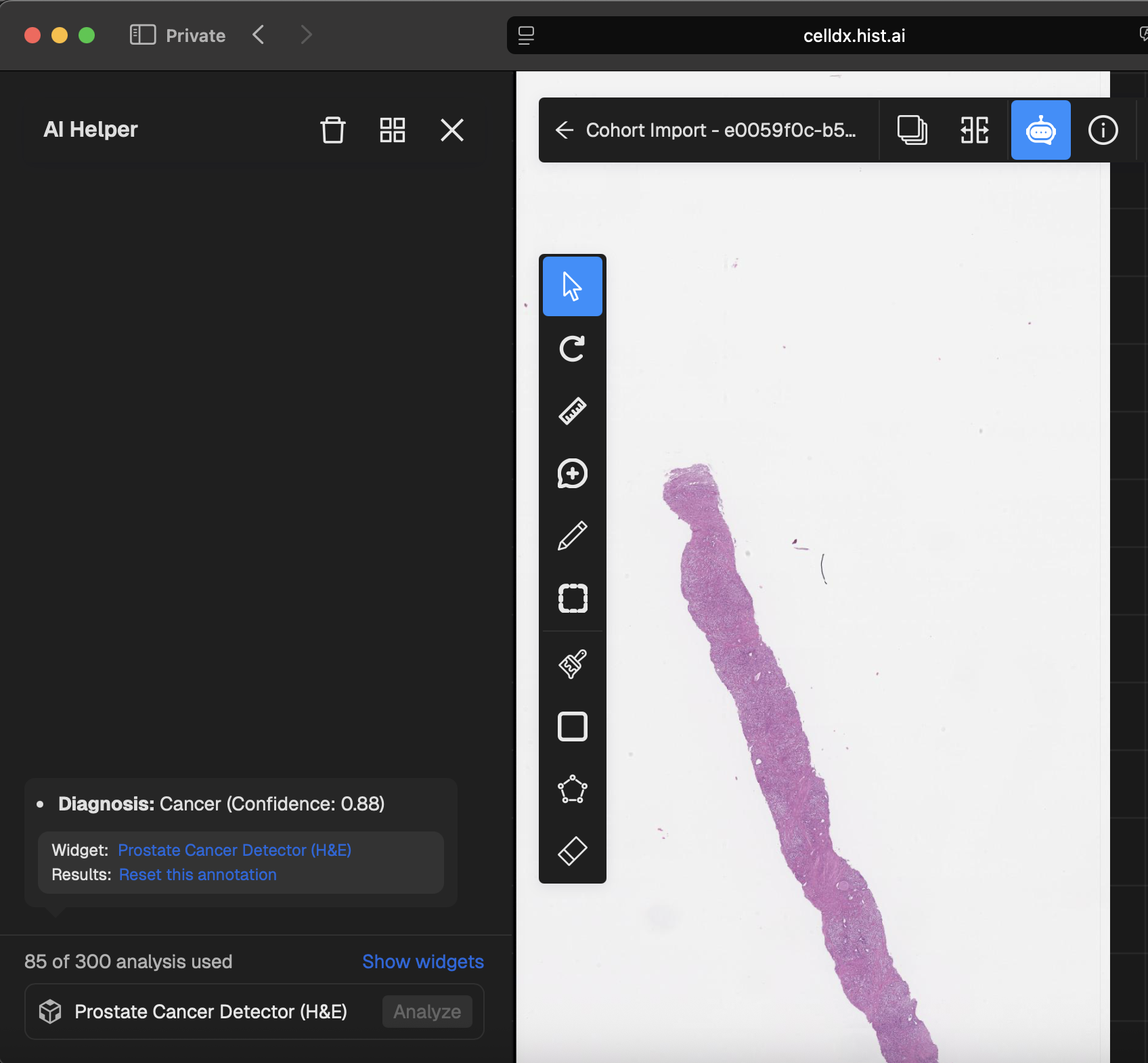
How it performs
Numbers below are from production tests in the week before launch.

Billing is $8 per GPU-hour of wall-clock time. The cluster autoscales to zero when idle, so there is no reserved-capacity floor and no minimum spend.
What's included
The platform ships with a curated feature store of 32,000+ cases and 66,000+ H&E slides spanning breast, colorectal, gastrointestinal, and other tissues. Access is included with the subscription — no per-cohort licensing, no data fees.
Who it's for
Researchers can train models without writing code. The agent handles training decisions and surfaces results in clinical terms.
ML practitioners and data scientists can run wide, cheap exploration: parallel jobs across cohort definitions and strategies, deterministic seeding for reproducibility, and built-in pairwise hyperparameter search. The agent skills are open-sourced at and can be audited or run against any compatible agent runtime.
Production-ready by default
Every artifact produced on the platform — features, weights, trained models — is licensed for commercial use, including downstream LDT development.
Business subscription: download trained weights and deploy them in your own environment. No per-inference royalties.
Audit trail: each job records its full configuration, cohort, seed, and metric history.
Azure-managed security: managed identities, private storage endpoints.
The same model you validate on the platform is the model you ship.
Getting started
Sign up at celldx.hist.ai now.
Technical preprint
For architectural details — agent skill design, MIL framework, hyperparameter search — see our preprint, CellDX AI Autopilot: Agent-Guided Training and Deployment of Pathology Classifiers (arXiv).